Highlights
Project snapshot
- Four-service architecture (web app, AI backend, prototype, cost-tracking service) over a 104-model, 209-migration Postgres schema.
- Config-driven multi-provider LLM orchestration across OpenAI, Anthropic, Gemini, Grok, and OpenRouter — model selected per feature and quality tier.
- Dedicated LLM cost-tracking service attributes token spend down to individual jobs and candidates via daily per-model rollups.
Overview
A hiring platform built as an operating system
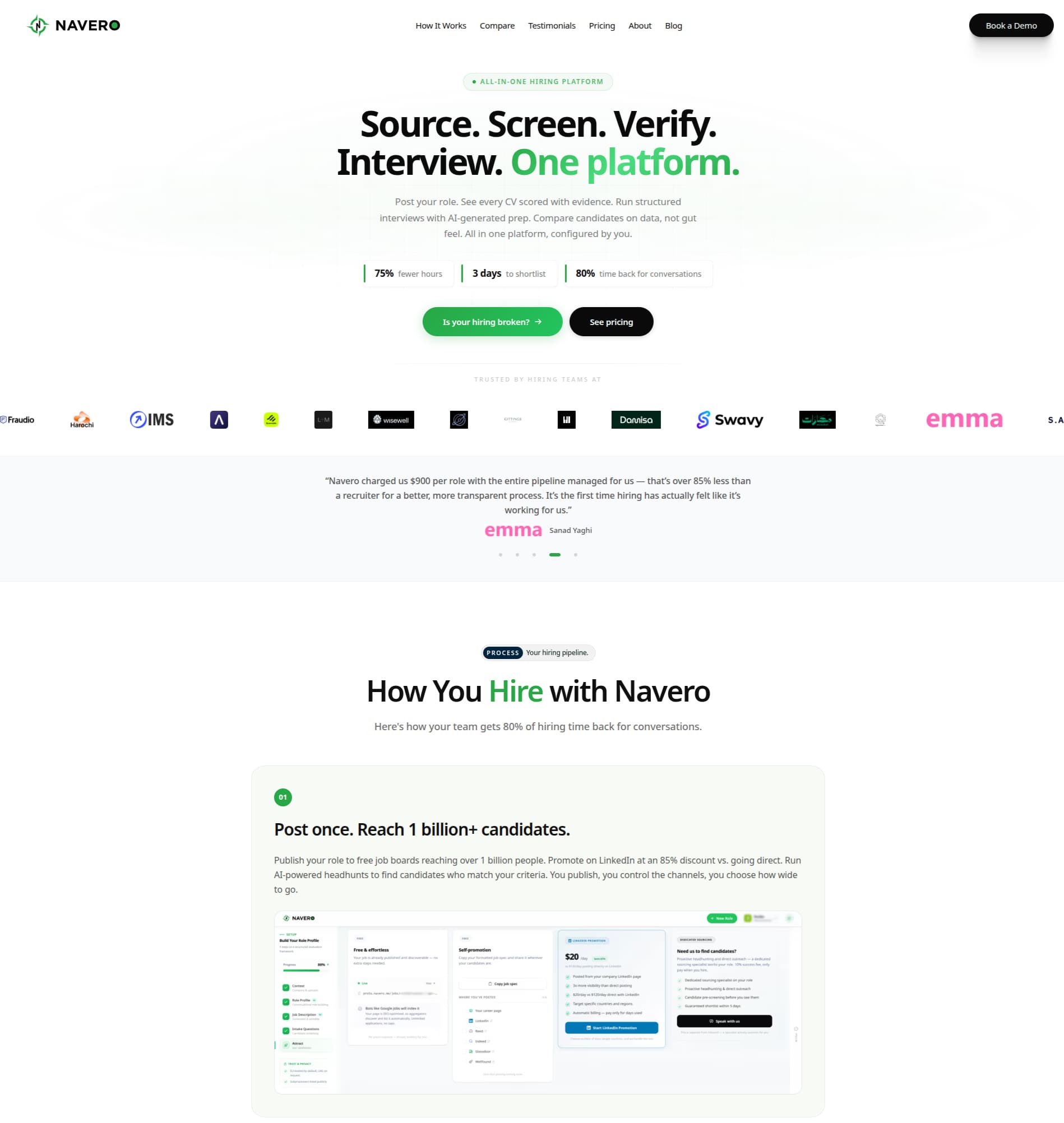
Navero is a multi-service AI hiring operating system that centralizes the full hiring lifecycle — role definition, sourcing, AI screening, interviews, operations, and billing — into one system of record.
A large Next.js 15 production app drives the recruiter workflow against a 104-model Postgres schema, while a dedicated FastAPI "Artemis" service owns all multi-provider LLM work behind a RabbitMQ-backed job worker. A separate service prices and aggregates every LLM call, and a Next.js 16 prototype explores a LangGraph-driven onboarding and public job-application flow.
Problem
Hiring was fragmented and AI spend was opaque
- Hiring workflows were split across separate tools for role setup, screening, interviews, and operations, with no single source of truth.
- Manual CV review and candidate screening at scale was slow, inconsistent, and expensive.
- Running many LLM features across many providers made cost and usage impossible to attribute per job or candidate.
- Producing high-quality, structured role definitions during employer onboarding was a recurring bottleneck.
Solution
A configurable AI pipeline behind a unified product
- Built Navero as a hiring operating system with dedicated services for product workflows, AI evaluation, and LLM cost tracking.
- Centralized all generative work in the Artemis backend so providers and models can be swapped or tuned per feature without touching product code.
- Treated AI performance and spend as first-class product concerns with a separate usage/billing tracking service.
Core Features
Capabilities across the full hiring lifecycle
Role Design & Job Specs
- AI job-title suggestion and full job-description generation
- Uploaded-description formatting and extraction
- Skills extraction with importance weights and coherence checks
Screening & Assessment
- Quiz / skill-test category generation and categorized binary questions
- Open-ended, clarifying, and smart-screening questions
- CV analysis via a dedicated consumer worker
Candidate Management & Sourcing
- Candidate aggregation, stage/round transitions, and knock-out logic
- Outbound sourcing with Exa-powered enrichment
- Referrals plus a tests / customer-success dashboard
Interviews & Scheduling
- Cal.com-embedded scheduling and interviewer-availability chasing
- Interview reminders and loops
- Meeting-bot capture via Recall.ai, AssemblyAI transcription, and Mux video
Operations, Billing & AI Cost
- Stripe checkout, pay-with-credits, and org/job billing
- Per-call token and cost capture with daily model rollups
- Per-job and per-candidate cost summaries
Architecture
Four services split by responsibility, AI tracking as a core layer
Users
→ navero-web (Next.js 15, ~276 API routes)
→ PostgreSQL / Prisma + Supabase + Redis
→ navero-llm / Artemis (FastAPI)
→ RabbitMQ llm_job worker
→ LLM providers (OpenAI / Anthropic / Gemini / Grok / OpenRouter)
→ navero-llm-tracking (token + cost rollups)
- Split across navero-web, navero-prototype-main, navero-llm, and navero-llm-tracking.
- Heavy AI work is delegated to Artemis with a RabbitMQ worker (connection pool, circuit breaker, health checks); long-running tasks flow through GCP Cloud Tasks (provisioned via Terraform).
- A dedicated AI service layer keeps orchestration out of the product UI and makes provider swaps a config change.
Technical Highlights
Production depth across application and AI infrastructure
Scale & Data
- 104 Prisma models and 209 migrations in the production web app
- Cost-tracking schema of 5 models with composite indexing and time-valid pricing rows
- Redis caching (ioredis) and Supabase SSR auth
AI Orchestration
- Provider adapters for OpenAI, Anthropic, Gemini, Grok, and OpenRouter (plus LiteLLM and the OpenAI Agents SDK)
- JSON llm-config maps each feature to a provider and a fast/normal/best quality tier
- LangGraph role-profile graph with decision-accumulator and document parsing in the prototype
Reliability & Ops
- Resilient RabbitMQ worker with graceful shutdown and a dedicated health server
- Sentry across web and backend, semantic-release CI, SonarQube, Jest
- Terraform IaC (stg/prod) with multi-stage Docker images
Business Value
A unified hiring stack with transparent AI cost control
- Reduces tool fragmentation by centralizing product, operations, and AI workflows in one platform.
- Improves hiring consistency through structured evaluation pipelines and shared candidate intelligence.
- Gives teams precise, per-job and per-candidate visibility into AI spend while keeping provider choice flexible.